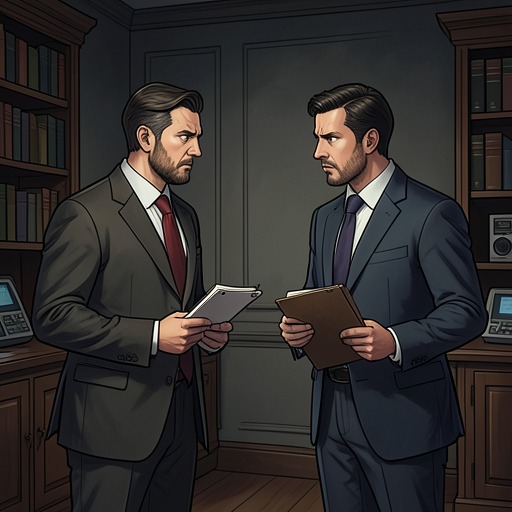
Andy Dalziel and Peter Pascoe’s professional partnership
Good Morning, Midnight (Reginald Hill Edition)Andy Dalziel and Peter Pascoe’s professional partnership is defined by friction that does not dissolve their working connection. When an apparent suicide draws them into the Maciver family’s affairs, Dalziel brings senior experience and an instinct for closing a case; Pascoe presses against premature conclusions. Their exchanges make the partnership a contest over who controls an investigation and what counts as enough evidence, but also a channel through which each man can challenge and inform the other.
Working Relationship and Authority
Their first encounter at the scene is not a formal briefing so much as a collision. Dalziel arrives amid disorder and becomes its new focus; Pascoe responds with an irritated question about why his superior is there. Dalziel answers the confusion around him by asking what is happening, while Pascoe replies that he has only just arrived and cannot know everything. The exchange establishes their familiar combative register: Dalziel needles, Pascoe refuses to pretend to certainty, and neither treats disagreement as a reason to stop talking.
Dalziel teases Pascoe about bringing his family, asking whether Rosie Pascoe is in the car. Pascoe explains that he was picking up Ellie Pascoe when he heard the call. The small joke places their professional encounter within an established personal familiarity, but it also lets Dalziel test Pascoe’s account of how he came to the scene. The tone is light on the surface; the investigation soon makes their differences more consequential.
Although Dalziel has arrived, he does not take charge. Pascoe asks directly whether Dalziel is assuming control, and Dalziel says the case is a simple suicide and that Pascoe, having arrived first, remains in charge. That answer both confirms Pascoe’s immediate authority and exposes Dalziel’s preliminary view of the death. Their arrangement therefore begins with a division between formal responsibility and the older detective’s confident interpretation, a division that Pascoe will repeatedly question.
Disagreement Over the Case
The physical circumstances initially seem to Dalziel to support suicide: the door is locked and bolted from the inside, the shutters are secure, and a gun is found between the dead man’s legs with one shoe and sock off. He treats these details as a collection of indications pointing in one direction. Pascoe resists the inference, and Dalziel mocks the possibility that he is looking for an elaborate locked-room explanation. Their dispute is not over whether the scene contains clues, but over whether its apparent coherence should end the inquiry.
The presence of a blue Laguna estate registered to Palinurus Maciver and the driver’s identification of him as the house’s designated keyholder give the scene a specific connection to the Maciver family. Dalziel warns against jumping to conclusions about the dead man’s identity even as the initial evidence seems to invite one. When Tom Lockridge emerges from the room looking unwell, Dalziel turns to him for information. Pascoe, by contrast, raises the possibility that the death may be a copycat suicide, linking it to the earlier death of Palinurus Maciver Senior. Dalziel calls his own visit idle curiosity, but Pascoe privately doubts that explanation. The gap between Dalziel’s stated reason and Pascoe’s reading of his actions becomes part of their unspoken negotiation.
Dalziel’s central distinction is procedural: if a person dies by unassisted suicide, he argues, no crime has been committed and no criminal investigation is necessary. Pascoe answers that suicide is never simple. Dalziel’s position is not that no questions exist, but that questions about motive fall outside the police task once assistance or criminal involvement has been excluded. Pascoe sees the unresolved motive as a reason to continue examining the case, especially because the dead man has left no note, only a Dickinson poem that appears to echo his father’s example. Dalziel dismisses the need for a more persuasive explanation, while Pascoe’s objection keeps the investigation open in his own mind.
Reversal and Renewed Scrutiny
The balance between them shifts as Pascoe’s inquiries bring the earlier death back into view. Dalziel learns that Pascoe has asked Shirley Novello to retrieve the files concerning Palinurus Maciver Senior’s suicide and has gone out with her. He confronts Pascoe directly, demanding to know what has happened that he does not know. The question makes his supervisory authority explicit, but it also acknowledges that Pascoe has been pursuing information beyond the account Dalziel thought he had settled.
Pascoe’s concern is concrete: he points to the absence of a note, the poem, and the possibility that the coroner will ask for a more convincing account of motive. Dalziel rebukes his language and insists that the state of mind behind a suicide is not the police’s concern if the death was unassisted. He then orders Pascoe to hand everything over to Paddy Ireland. The exchange turns their difference in investigative philosophy into a practical conflict over custody of the inquiry: Dalziel wants the case transferred and closed, while Pascoe has assembled questions he does not regard as answered.
That transfer is not the end of Pascoe’s work. He retrieves the bin liner containing the remnants of Palinurus Maciver Senior’s suicide and examines the Emily Dickinson volume. It remains open at a blood-spattered page, and he turns back to poem 870. The book links the present investigation to the earlier death through a particular object and a repeated literary trace. Pascoe’s attention to it shows how he works: an item that Dalziel treats as compatible with an uncomplicated account becomes, for Pascoe, a reason to compare the two cases more closely.
Pressure, Evidence, and Limits
As Pascoe reports what troubles him, Dalziel reads the material and listens. His response is not immediate agreement; a tense silence precedes his order that Pascoe has twenty-four hours, down to the second. He then clarifies that the deadline alone does not specify what he expects Pascoe to do. The moment captures their partnership at its most unstable: Dalziel imposes a narrow limit, yet leaves the task open enough to require further direction. The pressure is real, but so is the fact that Pascoe’s findings have compelled him to engage with the case rather than simply dismiss it.
Forensic details later complicate the scene that Dalziel had treated as self-explanatory. Arnold Gentry reports that the lock had recently been lubricated, and that ash inside it, along with some ash on the key, came from a source other than the fire in the waste bin. Dalziel had offered that fire as a straightforward explanation for ash on the key; the examination distinguishes traces that explanation cannot account for. Gentry also says that a palm print on a sheet Pascoe left with the investigators matches a print already found at the scene. Pascoe avoids Dalziel’s accusing stare, but the evidence described does not itself establish what the print means. Their exchange leaves the partnership in the difficult space between a suggestive clue and a proved conclusion.
The final recorded moment brings Dalziel, Pascoe, and Edgar Wield together after Pascoe switches off the tape. Wield looks away; Dalziel shifts in his chair and exhales, while Pascoe faces the silence. The scene offers no spoken settlement between the two detectives and no simple verdict on what the evidence has established. Instead, their shared presence at the end preserves the defining tension of the partnership: Pascoe continues to bring forward material that resists easy closure, and Dalziel must reckon with it even when his first instinct is to draw a line under the case.